The Corrosion Crisis: Why GFRP Rebar is the Long-Term Solution for India's Infrastructure
Steel corrosion is one of the biggest hidden threats to reinforced concrete structures, silently causing damage and costing billions globally in repairs and maintenance. In India, the challenge is even greater — diverse climates, coastal regions, and polluted urban zones all accelerate the corrosion process.
The science is straightforward but the consequences are severe. Chloride ions from seawater or road salts and carbon dioxide from air pollution penetrate concrete, attack the steel rebar inside, and destroy its protective oxide layer. Once corrosion begins, the steel can expand up to ten times its original volume — leading to cracks and fractures in the concrete, spalling where chunks break off, and progressive weakening of the overall structure.
This is not theory. It is happening every day to bridges and highways across India, coastal structures exposed to salt-laden air, and urban infrastructure facing pollution and humidity.
Why Traditional Steel Rebar Fails in India's Harsh Conditions
India's infrastructure faces a combination of challenges that accelerate steel corrosion faster than most builders expect:
- High humidity zones across coastal and riverine areas
- Aggressive coastal environments with salt-laden air
- Polluted metro regions with elevated CO₂ and chemical exposure
- Aggressive groundwater and soil chemistry in many regions
Traditional steel rebar cannot withstand these conditions for its full design life, leading to premature deterioration, inflated repair budgets, and serious safety risks.
The GFRP Rebar Solution: Non-Corrosive, Maintenance-Free Reinforcement
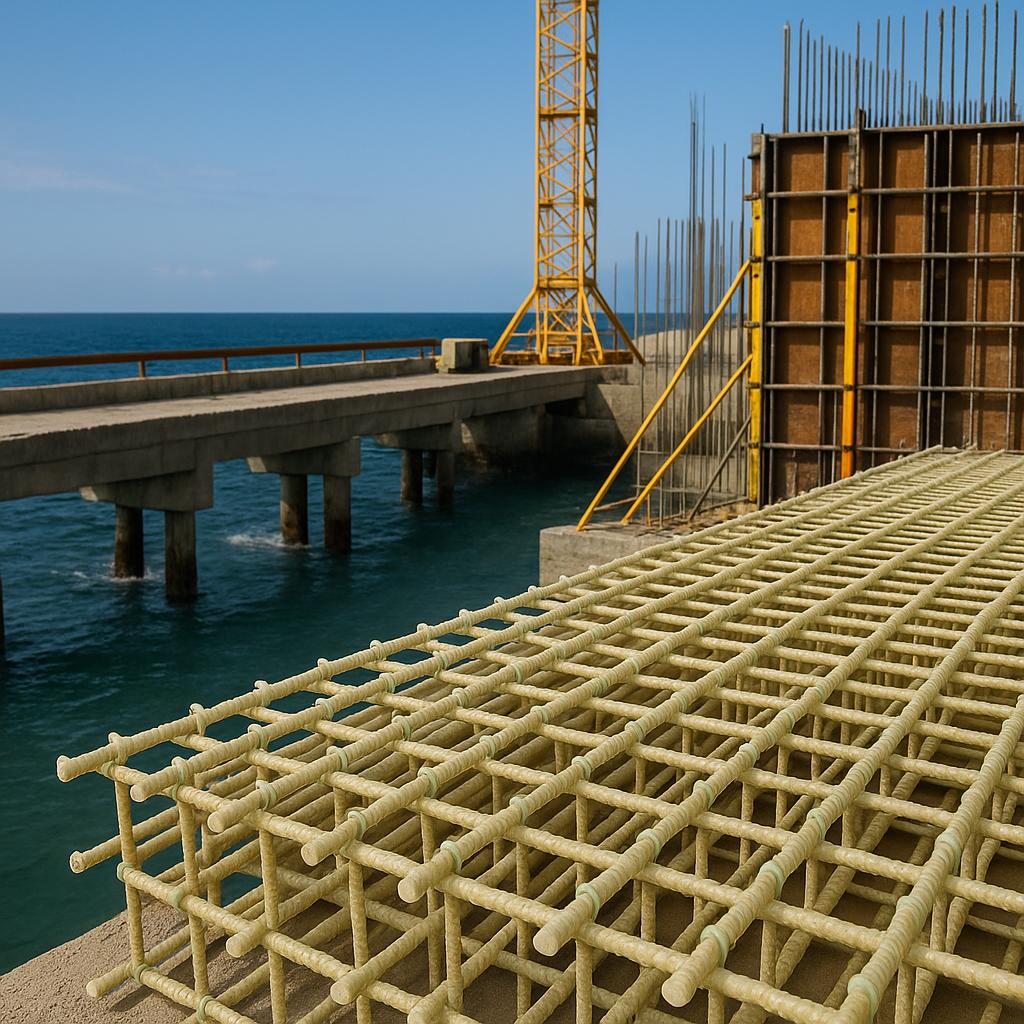
GFRP (Glass Fiber Reinforced Polymer) rebar is engineered to eliminate corrosion concerns entirely. Made from glass fibre and polymer resin — with no metal content — it cannot rust, regardless of the environment.
Key advantages of GFRP rebar from RN Elements:
- 100% non-corrosive — ideal for chloride-rich and moisture-heavy environments
- Over 100-year design life, significantly reducing lifecycle costs
- 4 times lighter than steel, simplifying transport, handling, and installation
- Higher tensile strength than Fe500 steel — suitable for highways, bridges, ports, and metro infrastructure
- Maintenance-free performance, even in the most extreme conditions
Choosing GFRP rebar is not just a material decision — it is an investment in durability, safety, and long-term cost savings.
Conclusion: Build for the Future, Not for Repairs
Steel corrosion silently destroys India's infrastructure — but the solution is clear. GFRP rebar from RN Elements offers unmatched durability for the country's toughest projects, from coastal bridges to metro rail networks.
📩 rnelementsllp@gmail.com | 📞 +91 9227990800
RN Elements — for creators who build a legacy.