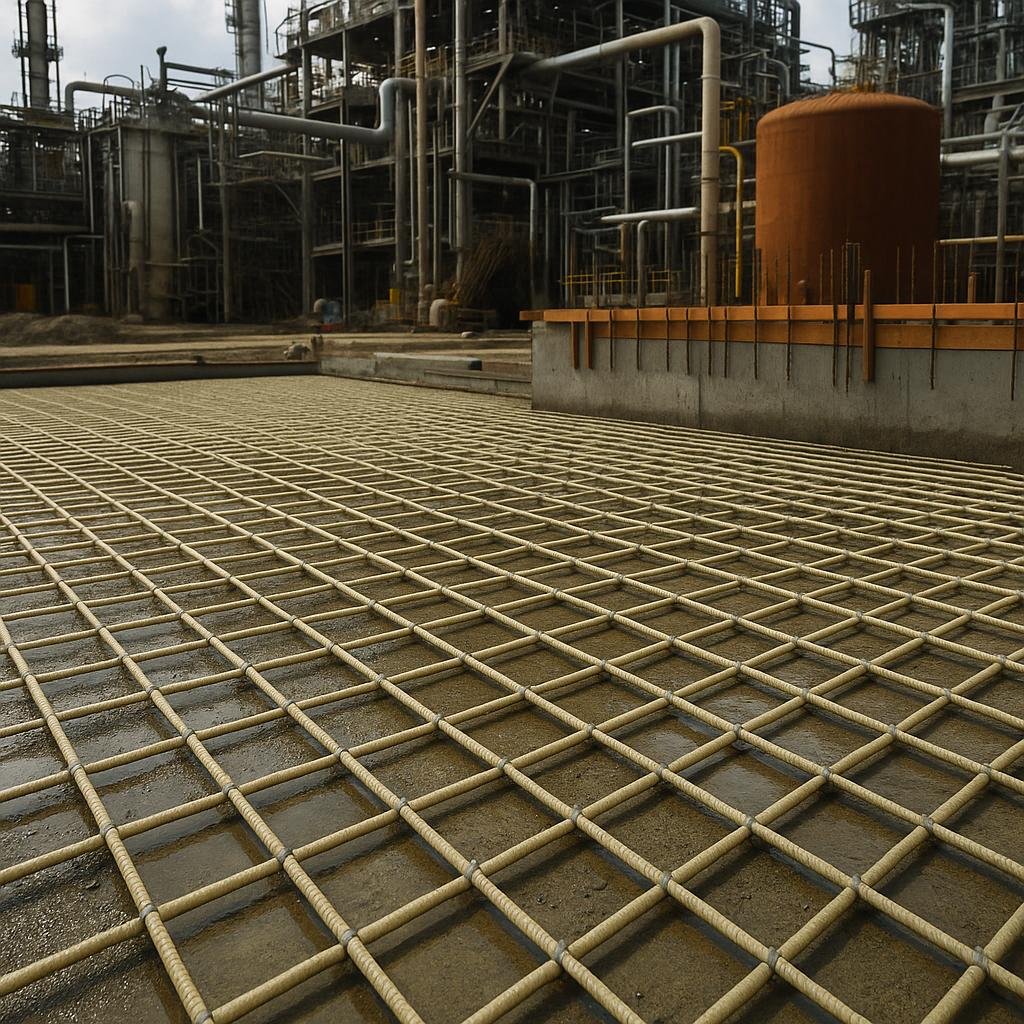
GFRP Rebar in Chemical Plants and Industrial Floors — Where Steel Simply Fails
There is one construction environment where the limitations of steel rebar become undeniable — chemical and industrial facilities.
Acids, alkalis, solvents, fertilisers, effluents, and industrial chemicals attack steel with ruthless efficiency. Structures that should last 30–50 years are often showing major corrosion damage within 8–12 years.
GFRP rebar was designed for exactly these conditions.
Why Steel Fails in Chemical Environments
Steel corrosion is driven by electrochemical reactions. In industrial environments, these reactions are accelerated by:
- Acid exposure — even mild acids rapidly strip the passive oxide layer on steel
- Chloride-rich environments — fertiliser plants, salt processing, food processing
- High humidity and condensation — common in enclosed industrial facilities
- Chemical spills — even indirect contact through cracked concrete
- Effluent channels and sumps — permanent moisture and chemical exposure
Once steel corrodes inside industrial floor slabs or plant foundations, the repair is expensive and disruptive — shutting down operations for weeks.
GFRP's Chemical Resistance Advantage
GFRP is made from glass fibre and polymer resin. It has no metallic components — there is nothing to oxidise or corrode.
GFRP rebar is resistant to: - Acids (except strong HF) - Alkalis and bases - Chlorides and salts - Organic solvents - Water and moisture
This is not a theoretical claim — it is the reason GFRP is used as the standard reinforcement material in water treatment plants, chemical processing facilities, and industrial floors worldwide.
Key Applications in Industrial and Chemical Environments
Chemical Plants - Foundation slabs in acid/alkali storage zones - Containment bund walls for chemical tanks - Internal floor slabs in production areas
Industrial Floors (Trimix and PCC) - Warehouse floors in food processing, pharmaceutical, and chemical units - Floors subject to regular washing with chemicals or water - Cold storage and refrigerated warehouse floors (freeze-thaw cycles + moisture)
Water and Effluent Treatment - Aeration tank walls and floors - Clarifier structures - Pump houses and chemical dosing areas
Fertiliser and Agrochemical Facilities - Storage hall floors - Loading bay slabs - Underground drainage structures
The Cost Case
A chemical plant floor reinforced with steel may need partial or full replacement within 10–15 years due to corrosion. The cost of shutting down operations, breaking out floor slabs, and replacing reinforcement is enormous.
A GFRP-reinforced floor in the same environment has: - Zero corrosion across its design life - No production downtime for structural repairs - Lower total cost even if GFRP is priced higher per kg (which, per metre, it is not)
Conclusion
For chemical plants, industrial floors, and any aggressive environment — GFRP rebar is not an option to consider. It is the correct engineering solution.
Do not wait for the floor to crack and the plant to shut down. Specify GFRP from the start.
👉 Contact RN Elements for industrial project supply →
📩 rnelementsllp@gmail.com | 📞 +91 9227990800
RN Elements — for creators who build a legacy.