📋 Table of Contents
- 1. Tensile Strength (Ultimate Tensile Strength / UTS)
- 2. Elastic Modulus (Stiffness)
- 3. Elongation at Break
- 4. Creep (Long-Term Sustained Load)
- 5. Fatigue Strength
- 6. Bond Strength
- 7. Transverse Shear Strength
- 8. Alkaline Resistance / Long-Term Durability
- 9. Coefficient of Thermal Expansion (CTE)
- Summary Table: GFRP vs TMT at a Glance
- Where GFRP Clearly Wins Over TMT
- Where TMT Still Has the Edge
- Need GFRP Rebar for Your Project?
GFRP Rebar Testing Parameters Explained: What IS 18256 Tests Actually Mean
When engineers and contractors look at a GFRP rebar datasheet, they see a wall of numbers — tensile strength, elongation, creep ratio, bond strength, transverse shear. Most of these are borrowed from steel testing standards and applied to GFRP, but the physics behind each test is quite different.
This guide explains every major test parameter in IS 18256:2023 (India's national standard for GFRP rebar) in plain language — what the test does, what the number means, and where GFRP performs differently from TMT steel.
1. Tensile Strength (Ultimate Tensile Strength / UTS)
What it is: The maximum pulling force per unit area a rebar can withstand before it snaps. Unit: MPa (N/mm²)
Simple example: Pull a rubber band from both ends until it breaks. The force at the point of breaking, divided by the cross-section area, is tensile strength.
GFRP vs TMT: TMT Fe500 is ~500–550 MPa. GFRP 8mm (RN Elements) is 1000+ MPa — often 1100–1200 MPa. GFRP is 2x stronger in tension than TMT. The glass fibers running along the length carry the load, and glass fiber in tension is exceptionally strong.
Where GFRP can fail here: If fibers are poorly wetted by resin during pultrusion, or voids are present, tensile strength drops sharply. Manufacturer quality control is critical.
Hinglish mein: Bar ko donon taraf se kheencho — woh kitne force par tootegi, woh hai tensile strength. GFRP ki tensile strength TMT se 2 guna zyada hoti hai. Ek chhota sa bar bhi zyada load uthata hai. Par agar factory mein resin theek se nahi laga toh yeh number gir jaata hai — isliye manufacturer ki quality important hai.
2. Elastic Modulus (Stiffness)
What it is: How rigid the bar is — how much it resists bending under load. Unit: GPa
Simple example: A rubber band and a steel wire might both hold the same weight, but the steel barely stretches. Steel has a higher elastic modulus.
GFRP vs TMT: TMT Steel is ~200 GPa. GFRP is ~40–60 GPa — about 1/4th of steel. This is GFRP's biggest limitation. Slabs reinforced with GFRP deflect more under the same load even if they do not crack. Designers must compensate by increasing slab depth or rebar quantity.
Hinglish mein: Yeh decide karta hai ki bar load ke neeche kitna jhukegi. GFRP, steel se 4 guna zyada flexible hai — same load mein zyada bend karegi. Isliye designer ko slab thodi thick rakhni padti hai ya zyada bars daalne padte hain. Yeh GFRP ki sabse badi weakness hai.
3. Elongation at Break
What it is: How much the rebar stretches as a % of its original length before it finally breaks.
GFRP vs TMT: TMT steel elongates 12–16% — it yields and bends visibly before breaking, giving a warning. GFRP elongates only 1.5–2.5% — it snaps suddenly with no prior bending.
Steel is ductile — it bends before it breaks. GFRP is brittle in tension — it snaps without warning. This is why GFRP is not used as primary reinforcement in columns or earthquake-critical moment frames.
Hinglish mein: Steel tootne se pehle muda karta hai — danger aane ka signal deta hai. GFRP seedha snap karta hai bina kisi warning ke. Socho rubber band vs glass rod — glass seedha tootega bina jhuke. Isliye earthquake zones mein columns mein GFRP use nahi hoti.
4. Creep (Long-Term Sustained Load)
What it is: If you apply a constant load for months or years, does the bar slowly deform and eventually snap even below its rated strength? That slow deformation under sustained load is creep.
Simple example: Hang a heavy bucket from a nylon rope for 50 years. Steel wire barely changes. The nylon slowly stretches and may snap at a load much lower than it initially survived. That is creep rupture.
GFRP behavior: IS 18256 limits sustained design stress to about 20–25% of UTS (vs ~60% for steel). A 1000 MPa bar should not be permanently stressed beyond ~200–250 MPa for long-term loads. This is already factored into IS 18256 design reduction factors — it does not mean the bar is unsafe, just that design must account for it.
Hinglish mein: Socho ek bhari almirah saalon tak usi jagah rakhi ho — slowly zameen dab jaaye. Yahi creep hai. GFRP mein yeh hota hai isliye permanent loads ke liye uski total capacity ka sirf 20–25% use karte hain design mein. Ghabrana nahi — yeh already engineer ke calculation mein hota hai.
5. Fatigue Strength
What it is: If a bar is loaded and unloaded repeatedly — like a bridge with thousands of trucks crossing daily — does it weaken over time even though each load is within safe limits?
Simple example: Bend a paper clip back and forth 20 times — it snaps even though you never applied full force. That is fatigue failure.
GFRP vs TMT: TMT steel handles high stress cycles excellently. GFRP is adequate for most buildings and slabs, but bridge designers and dynamic-load structures must verify fatigue life against IS 18256 requirements.
Hinglish mein: Bar-bar load aaye aur jaye — jaise highway pe trucks ya port pe cranes. Bahut zyada cycles ke baad material andar se kamzor ho sakta hai bina dikhaye. Buildings ke liye GFRP bilkul theek hai. Bridges ya heavy dynamic load ke liye engineer fatigue calculate karega.
6. Bond Strength
What it is: How well the rebar grips the surrounding concrete. If a rebar pulls out cleanly, that is a bond failure — structurally catastrophic. Unit: MPa
Simple example: Push a pencil into soft clay and try to pull it out. A pencil with a spiral groove grips much better — that is the principle behind helical winding.
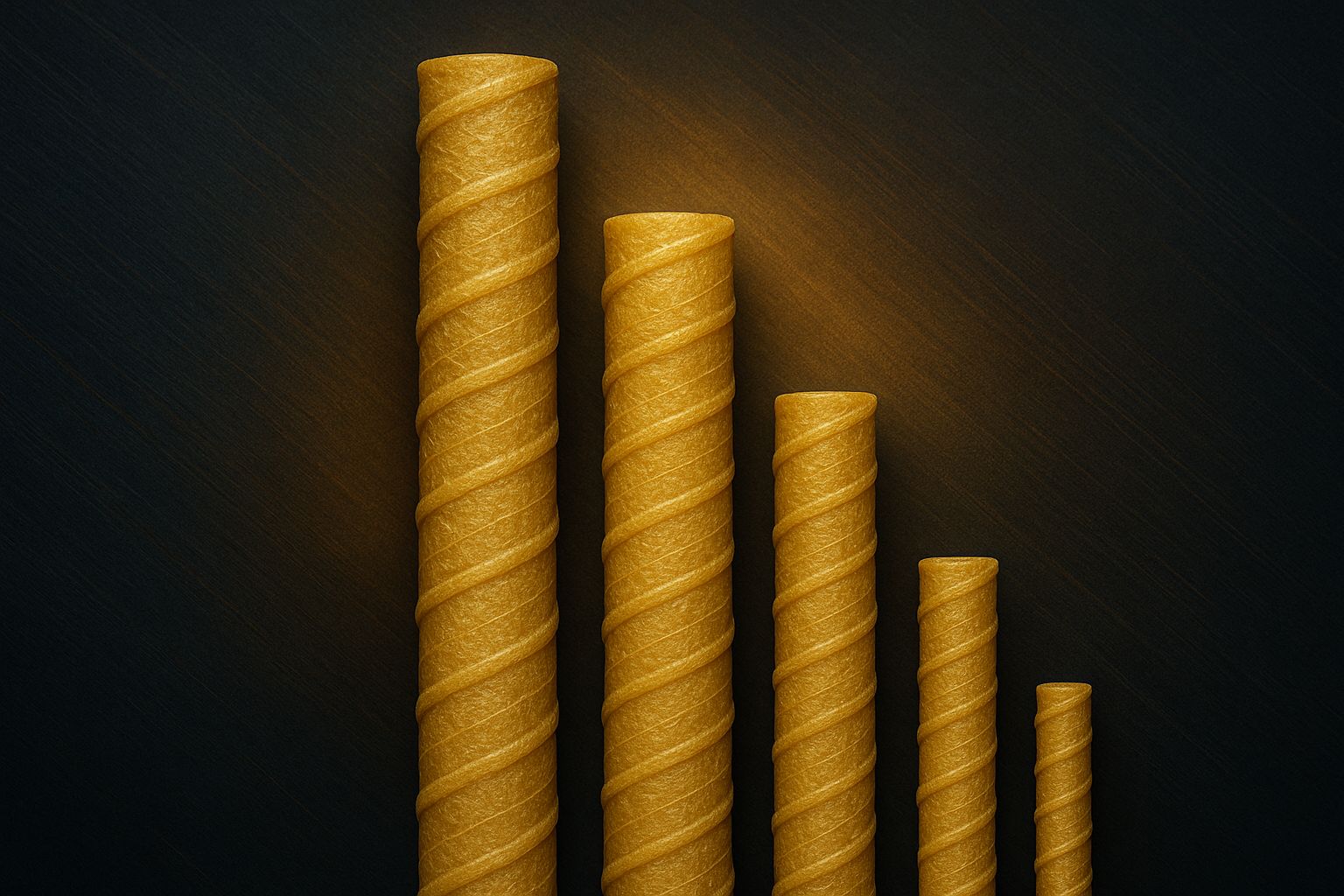
GFRP vs TMT: TMT steel has ribs that mechanically interlock with concrete. RN Elements GFRP uses helical winding — a continuous spiral fiber wound around the bar surface during production. This creates a mechanical interlock with concrete similar to TMT ribs, meeting IS 18256 minimum bond strength requirements.
Hinglish mein: Bar concrete ko pakad ke rakhti hai — yeh pakad kitni mazboot hai woh hai bond strength. Humare RN Elements GFRP mein helical winding hoti hai — production ke time ek spiral fiber bar ke upar wind kiya jaata hai. Yeh spiral concrete mein ghus jaata hai aur bar ko mazbooti se pakad ke rakhta hai. Bilkul TMT ke ribs ki tarah kaam karta hai.
7. Transverse Shear Strength
What it is: The force needed to cut through the bar sideways — perpendicular to its length. Unit: MPa
Simple example: Scissors cutting a wire apply shear force across it. Transverse shear strength is how resistant the rebar is to being cut across.
GFRP vs TMT: Steel is isotropic — same strength in all directions. GFRP is anisotropic — fibers run lengthwise, so cutting across them is much easier. GFRP transverse shear is only 15–30% of its tensile strength.
Critical site rule: GFRP stirrups must be bent at the factory. Bending GFRP on-site after curing destroys the fibers at the bend point and creates a weak failure zone.
Hinglish mein: Bar ko side se kaatne ki resistance. GFRP yahan steel se kamzor hai kyunki fibers sirf lengthwise hain. Isliye GFRP ke stirrups factory mein hi modte hain, site pe nahi. Agar site pe moda toh woh point toot jaayega — yeh bhool kabhi mat karna.
8. Alkaline Resistance / Long-Term Durability
What it is: Concrete is highly alkaline (pH 12–13). Over decades, does this environment degrade the rebar from inside the structure?
GFRP behavior: E-CR glass (used in quality GFRP) has excellent alkali resistance. IS 18256 requires rebar to retain minimum tensile strength after alkaline conditioning at elevated temperature — simulating decades of real exposure.
The steel comparison: Once chlorides (seawater, de-icing salts) or carbonation break down steel's passivation layer, rust begins. Rust expands 3–4x in volume, cracking the concrete from inside. GFRP does not corrode at all — this is its single most important long-term advantage.
Hinglish mein: Concrete ke andar bahut zyada alkaline environment hota hai. TMT wahan saalon baad zaang (rust) lagke kharab hoti hai — aur rust phailti hai toh concrete andar se phoot jaata hai. GFRP kabhi rust nahi karta. Samundar ke paas, chemical plant mein, sewer ke upar — GFRP 50 saal baad bhi naye jaisi rahegi. Yeh ek line mein GFRP ki sabse badi jeet hai.
9. Coefficient of Thermal Expansion (CTE)
What it is: How much the bar expands or contracts per degree of temperature change.
GFRP vs Concrete vs Steel: Concrete and Steel are ~10–12 x 10-6/°C (well matched). GFRP longitudinal is ~6–9 x 10⁻⁶/°C (reasonably matched to concrete). GFRP radial/transverse is ~20–23 x 10-6/°C — higher, which can cause micro-cracking at the rebar-concrete interface under extreme temperature swings in desert regions or cold storage facilities.
Hinglish mein: Garmi mein bar thodi badi hoti hai, thandi mein choti. GFRP aur concrete ka yeh expansion length mein mostly match karta hai — theek hai. Par GFRP radial direction (side se) mein thoda zyada expand karta hai. Desert ya cold storage jaisi jagah pe designer isko dhyan mein rakhta hai.
Summary Table: GFRP vs TMT at a Glance
| Parameter | TMT Fe500 | GFRP (IS 18256) | GFRP Better? |
|---|---|---|---|
| Tensile Strength | ~500 MPa | 1000+ MPa | Yes — 2x stronger |
| Elastic Modulus | ~200 GPa | ~40–60 GPa | No — less stiff |
| Elongation / Ductility | 12–16% | 1.5–2.5% | No — brittle |
| Corrosion Resistance | Poor | Excellent | Yes |
| Weight | 7850 kg/m³ | ~2100 kg/m³ | Yes — 75% lighter |
| Creep Under Sustained Load | Low concern | Design reduction needed | Limitation |
| Bond Strength | Good (ribs) | Good (helical winding) | Equal / Better |
| Transverse Shear | High | 15–30% of UTS | No |
| Fatigue | Excellent | Adequate | Context-dependent |
| Non-magnetic / Non-conductive | No | Yes | Yes |
Where GFRP Clearly Wins Over TMT
- Marine and coastal structures — seawater destroys TMT within 10–15 years. GFRP has a 75+ year design life.
- Chemical plants and wastewater treatment — acids and chemicals corrode steel. GFRP is chemically inert.
- MRI rooms and electromagnetic-sensitive areas — GFRP is non-magnetic and non-conductive.
- Road pavements and industrial floors — no corrosion means no spalling or cracking from below.
- Lightweight precast panels — 75% lighter than steel-reinforced panels, reducing crane and transport costs.
Where TMT Still Has the Edge
- Columns under seismic loads — steel's ductility absorbs earthquake energy; GFRP is brittle.
- Deflection-sensitive slabs — steel's higher stiffness controls deflection better with less material.
- On-site bending required — GFRP cannot be field-bent; all shapes must be factory-made.
Need GFRP Rebar for Your Project?
RN Elements manufactures IS 18256:2023 compliant GFRP rebar from our pultrusion facility in Surat, Gujarat — available in 4mm to 32mm diameters with helical winding for superior bond performance.
We provide complete test reports, technical data sheets, and project-specific engineering support for structural engineers, contractors, and procurement teams.
If you are evaluating GFRP rebar for a coastal structure, chemical plant, water treatment facility, or any corrosion-critical project — talk to us before finalizing your specification.
📩 rnelementsllp@gmail.com | 📞 +91 9227990800
RN Elements — for creators who build a legacy.
Disclaimer: Performance figures are indicative. Always refer to manufacturer test certificates and consult a licensed structural engineer for project-specific design decisions.