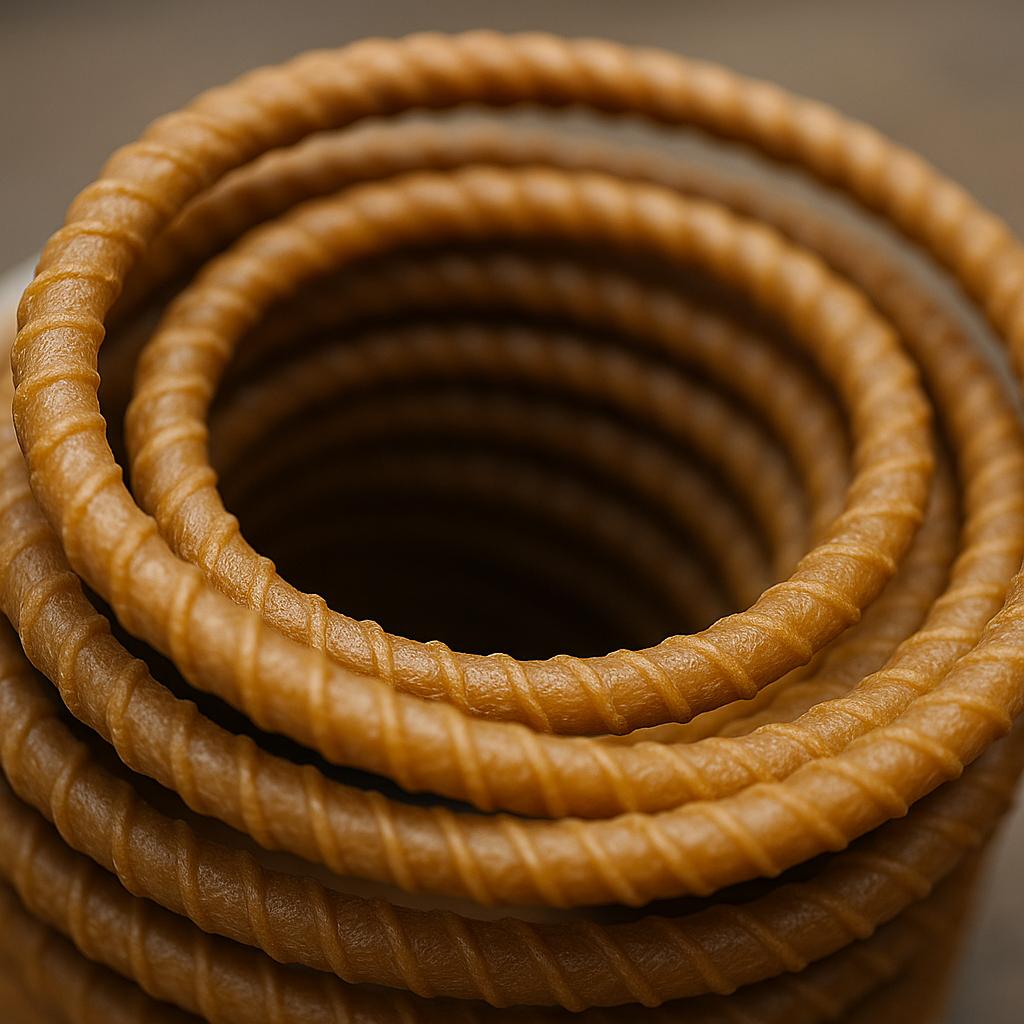
How GFRP Rebar Reduces Total Project Cost — Beyond the Per-Kg Price
Many builders and developers encounter GFRP rebar, see the per-kg price, and stop the conversation there. That is a costly mistake.
The per-kg price is one number. Your project cost is ten numbers. And when you add them all up, GFRP wins.
Here is the complete breakdown.
Cost Driver 1: Material Cost Per Metre
The comparison starts here.
For 12mm rebar: - Steel: 0.888 kg/m × ₹65 = ₹57.72 per metre - GFRP: 0.234 kg/m × ₹200 = ₹46.80 per metre
⚠️ Prices used are for calculation illustration only. Actual prices vary. Contact RN Elements for current pricing.
GFRP is ₹10.92 cheaper per running metre — before any other savings.
⚠️ Note: Prices used above (₹65/kg steel, ₹200/kg GFRP) are indicative and for illustration only. Actual prices vary. Contact RN Elements for current pricing.
At 10,000 metres, that is ₹1,09,200 saved on material alone.
Cost Driver 2: Freight and Logistics
Steel for 10,000 metres of 12mm rebar weighs 8,880 kg.
GFRP for the same job weighs 2,340 kg.
That is 3.8× less freight weight.
On a 300 km haul, freight savings easily reach ₹20,000–₹40,000 per consignment. On large projects with multiple deliveries, this becomes a significant line item.
Cost Driver 3: Labour and Installation
GFRP is 74% lighter than steel. On site, this means:
- Fewer workers needed to carry and place bars
- No crane or heavy equipment needed for standard bars
- Faster placement speed — contractors report 15–25% faster rebar placement
- Less physical fatigue, fewer injuries
For a large project, labour savings from faster GFRP placement can run into lakhs.
Cost Driver 4: Concrete Cover
Because GFRP does not corrode, minimum concrete cover can potentially be reduced in certain applications compared to steel.
Less cover = less concrete = lower material cost per slab or wall.
(Always follow structural engineer specification and applicable standard.)
Cost Driver 5: Maintenance Cost Over 20–30 Years
This is the biggest cost driver of all — and the one most builders ignore.
Steel corrodes. In coastal, underground, or industrial environments — corrosion begins within 8–15 years. Repair costs for corroded concrete structures range from ₹500 to ₹2,000+ per sq. ft.
GFRP does not corrode. Maintenance cost: zero.
For a 5,000 sq. m structure, a single major repair cycle can cost ₹25 lakh to ₹1 crore depending on severity.
GFRP eliminates this entirely.
Total Cost Comparison Summary
| Cost Driver | Steel | GFRP |
|---|---|---|
| Material per metre | Higher | Lower ✅ |
| Freight | Higher | Lower ✅ |
| Site labour | Higher | Lower ✅ |
| Concrete cover | Standard | Potentially reduced ✅ |
| 20-year maintenance | High | Zero ✅ |
| Total project cost | High | 25–40% lower overall ✅ |
Who Benefits Most
- Industrial facility owners — no production downtime for floor repairs
- Real estate developers — better long-term asset value
- Infrastructure contractors — lower total project bid
- Government project managers — lower lifecycle cost, better value for public money
- Coastal and marine project developers — the most dramatic savings
Conclusion
GFRP rebar is not a premium product with a premium price. It is a smart engineering choice that reduces your total project cost across multiple dimensions.
Stop comparing ₹/kg. Start comparing total project cost. When you do — GFRP wins every time.
👉 Get a full project cost analysis from RN Elements →
📩 rnelementsllp@gmail.com | 📞 +91 9227990800
RN Elements — for creators who build a legacy.